Self-Mastery · Guide 02
Emotional Loops
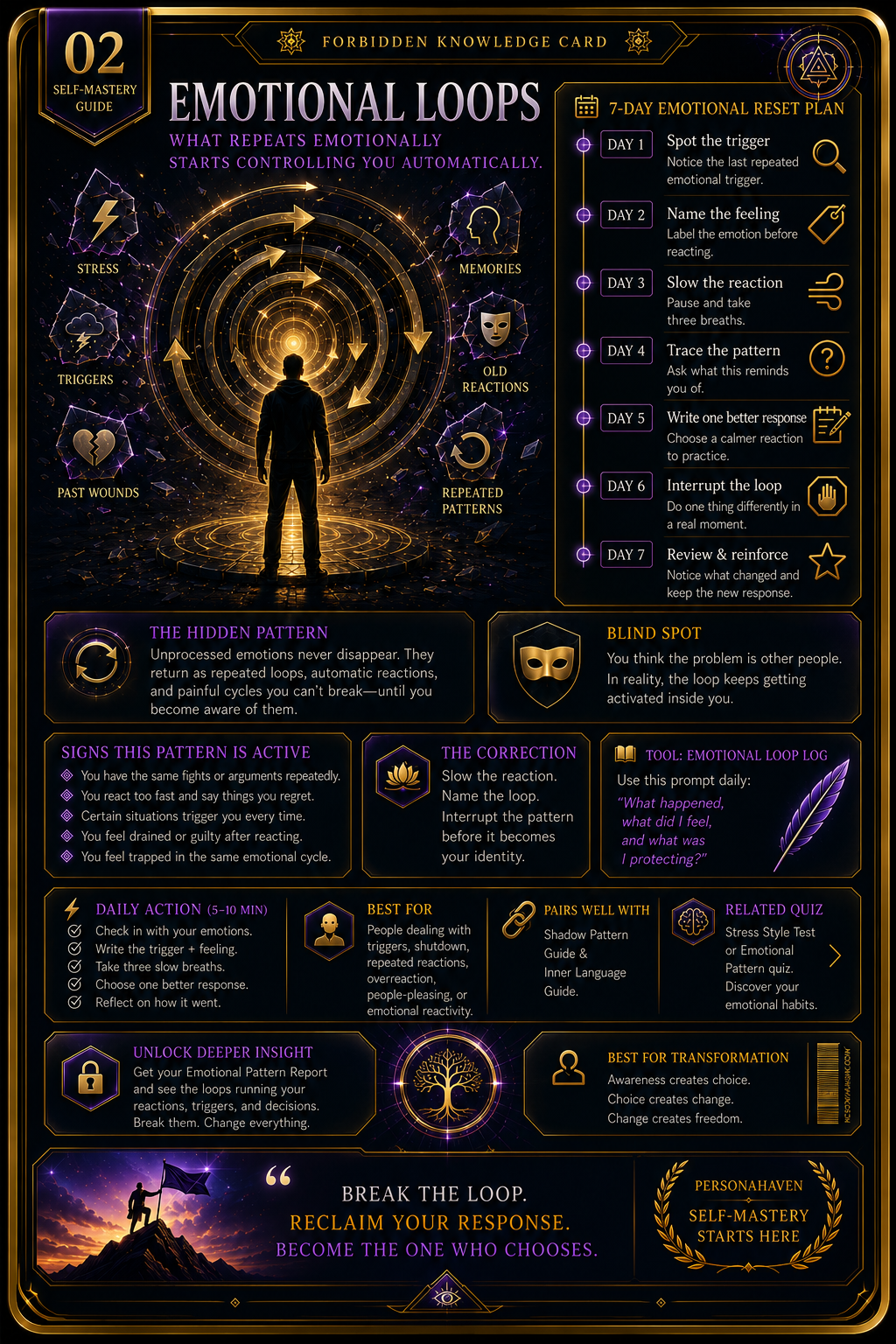
In this guide, an emotional loop means a repeating trigger, feeling, and reaction pattern, such as becoming angry, withdrawing, or replaying the same worry. To interrupt it, notice the trigger, name the feeling, and choose one slower response.
What repeats emotionally starts controlling you automatically.
What Is an Emotional Loop?
In this guide, an emotional loop means a trigger, feeling, and reaction pattern you keep returning to, even when you know the response does not help.
It might look like anger, shutdown, overthinking, guilt, defensiveness, people-pleasing, or the same argument happening again with a different person.
The emotion may feel new each time.
The pattern usually is not.
Attention control is about where your mind goes. Emotional loops are about what your mind keeps replaying.
The Hidden Pattern
Unprocessed emotions do not always disappear with time.
Sometimes they become shortcuts.
A certain tone. A delayed reply. A critical comment. A feeling of being ignored. Suddenly your system reacts before you have chosen anything.
You are not responding to the moment alone.
You may be responding to every similar moment your mind has stored behind it.
That is why the reaction can feel bigger than the situation.
Signs This Pattern Is Active
- You have the same fights or arguments repeatedly.
- You react too fast and say things you regret.
- Certain situations trigger you every time.
- You feel drained or guilty after reacting.
- You feel trapped in the same emotional cycle.
The Blind Spot
You may think the problem is other people.
Sometimes it is.
But if the same emotional reaction keeps appearing in different places, the loop is also happening inside you.
That does not mean you are wrong to feel what you feel.
It means your reaction has become automatic. And anything automatic can start making choices for you.
The Correction Path
Slow the reaction.
Name the loop.
Interrupt the pattern before it becomes your identity.
You do not need to become emotionless. That would be fake control.
You need enough space between the feeling and the response to choose what happens next.
The first win is not “staying calm forever.”
The first win is noticing the loop before it finishes itself.
Daily Action
Use the card’s daily action for 5–10 minutes:
Check in with your emotions.
Write the trigger and the feeling.
Take three slow breaths.
Choose one better response.
Then reflect on how it went.
Simple. Not easy. But it breaks the automatic chain.
7-Day Emotional Reset Plan
Day 1 — Spot the trigger
Notice the last repeated emotional trigger. What keeps setting off the same reaction?
Day 2 — Name the feeling
Label the emotion before reacting. Be specific. “Angry” is useful, but “dismissed,” “cornered,” or “embarrassed” may be closer.
Day 3 — Slow the reaction
Pause and take three breaths before replying, explaining, defending, or shutting down.
Day 4 — Trace the pattern
Ask yourself: “What does this remind me of?” The answer may explain why the reaction feels so intense.
Day 5 — Write one better response
Choose a calmer reaction to practice. Not perfect. Just better than the old loop.
Day 6 — Interrupt the loop
Do one thing differently in a real moment. Lower your voice. Ask a question. Step away. Say, “I need a minute.”
Day 7 — Review & reinforce
Notice what changed. Keep the response that gave you more control, less regret, or a clearer result.
Journal Prompt
What happened, what did I feel, and what was I protecting?
When this emotion repeats, what response do I usually choose — and what does it cost me?