Self-Mastery · Guide 01
Attention Control
Your attention isn’t just what you’re looking at.
It’s the remote control for your mood, energy, and choices.
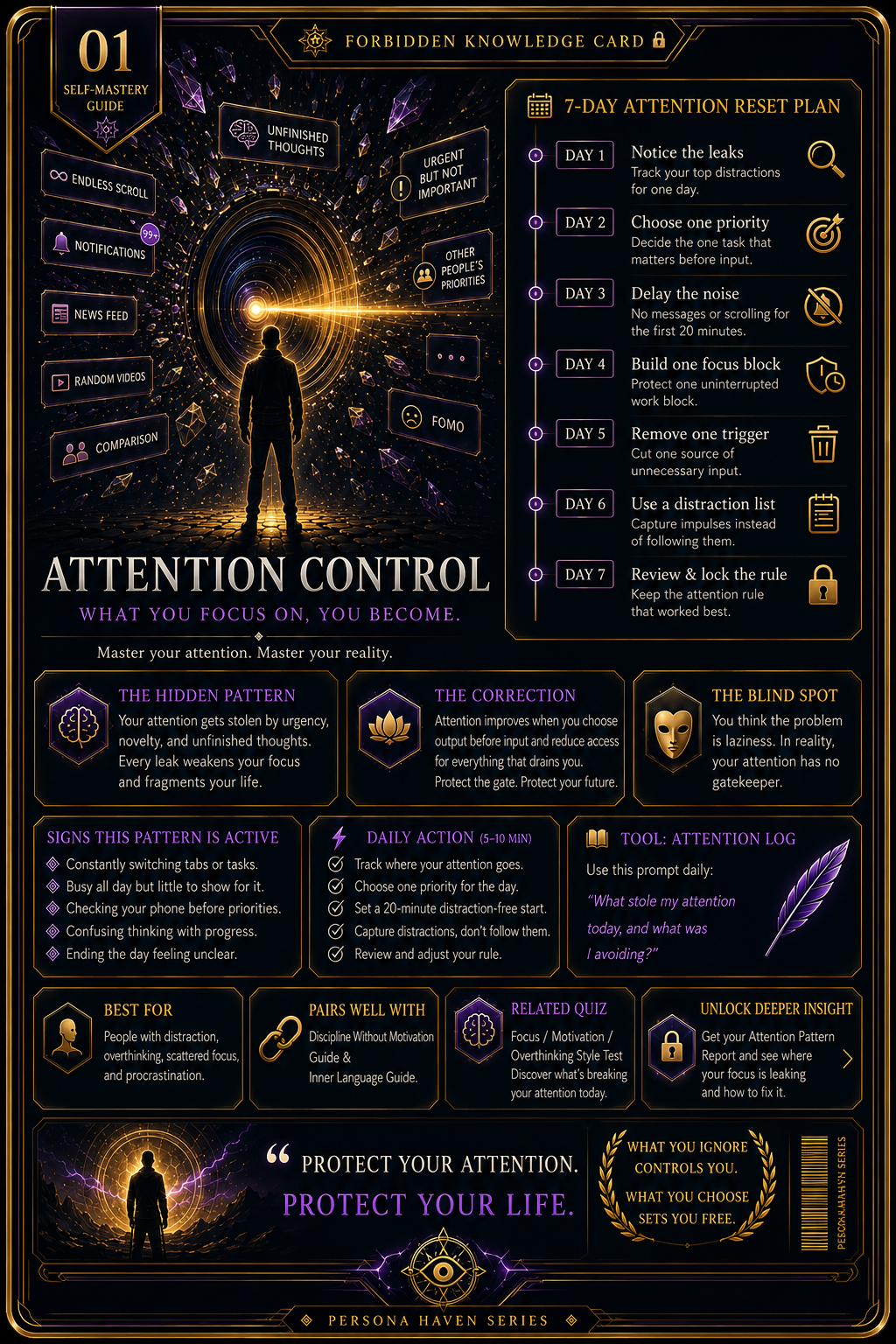
What This Means
Attention control means you can choose where your mind goes instead of letting every notification, worry, urge, or random thought pull you around.
It is not about forcing yourself to concentrate all day.
It is about catching the moment your mind gets hijacked — then bringing it back before your whole day gets dragged with it.
If you can control your attention, you do not need perfect motivation. You become harder to distract, harder to manipulate, and harder to derail.
The Hidden Pattern
Most people do not lose control of their life in one dramatic moment.
They lose it through small attention leaks.
A quick scroll becomes half an hour. A small worry becomes the main story of the day. One message changes your mood before you even understand why.
You spend the day reacting to things instead of deciding them.
You are busy, but you are not moving.
Signs This Pattern Is Active
- You check your phone without knowing why.
- You feel mentally exhausted even when you “didn’t do much.”
- You avoid high-priority work by doing easy, low-pressure tasks.
- You lose time to random tabs, searches, videos, and scrolling.
The Blind Spot
You may think your problem is laziness.
It may not be.
Your attention has simply become too easy to rent out.
Apps rent it. Other people rent it. Worry rents it. Boredom rents it. Even your own impulses know how to take it without asking.
That is the part most people miss.
Your attention is valuable. That is why so many things are built to capture it.
The Correction Path
Stop treating attention like an unlimited background setting.
Treat it like a limited resource.
You do not need to become extreme. You need to become less available.
Fewer open tabs. Fewer pointless checks. Fewer “quick looks” that turn into lost time.
Start with one rule:
Before you give something your attention, ask whether it deserves access to your mind right now.
Daily Action
Use the card’s center rule for 5–10 minutes:
Choose one thing that deserves your full attention today.
Not five things. Not a perfect plan. One thing.
Then protect a small window for it before the noise gets in.
7-Day Practice
Day 1 — Notice the leaks
Pay attention to where your focus disappears most often. Do not fix it yet. Just notice the pattern.
Day 2 — Choose one priority
Pick one task that actually matters today. Write it down clearly enough that you cannot pretend you forgot.
Day 3 — Delay the noise
Before opening your phone, messages, videos, or random tabs, wait five minutes. Make the urge prove it is necessary.
Day 4 — Build one focus block
Work on your chosen task for 20 minutes with no checking, switching, or background scrolling.
Day 5 — Remove one trigger
Move one distraction out of reach. Silence it, close it, delete the shortcut, or put the device somewhere inconvenient.
Day 6 — Use a distraction list
When a random thought appears, write it down instead of following it. Your mind can return to it later if it still matters.
Day 7 — Review & lock the rule
Look back at the week. Find the one rule that helped most, then keep it for the next seven days.
Journal Prompt
Where does my attention go when I feel stressed, bored, or uncomfortable?
What would change if I protected my focus as seriously as I protect my money?