Self-Mastery · Guide 09
Fear Mapping
Fear hides where it stays unnamed.
Mapping it turns panic into direction.
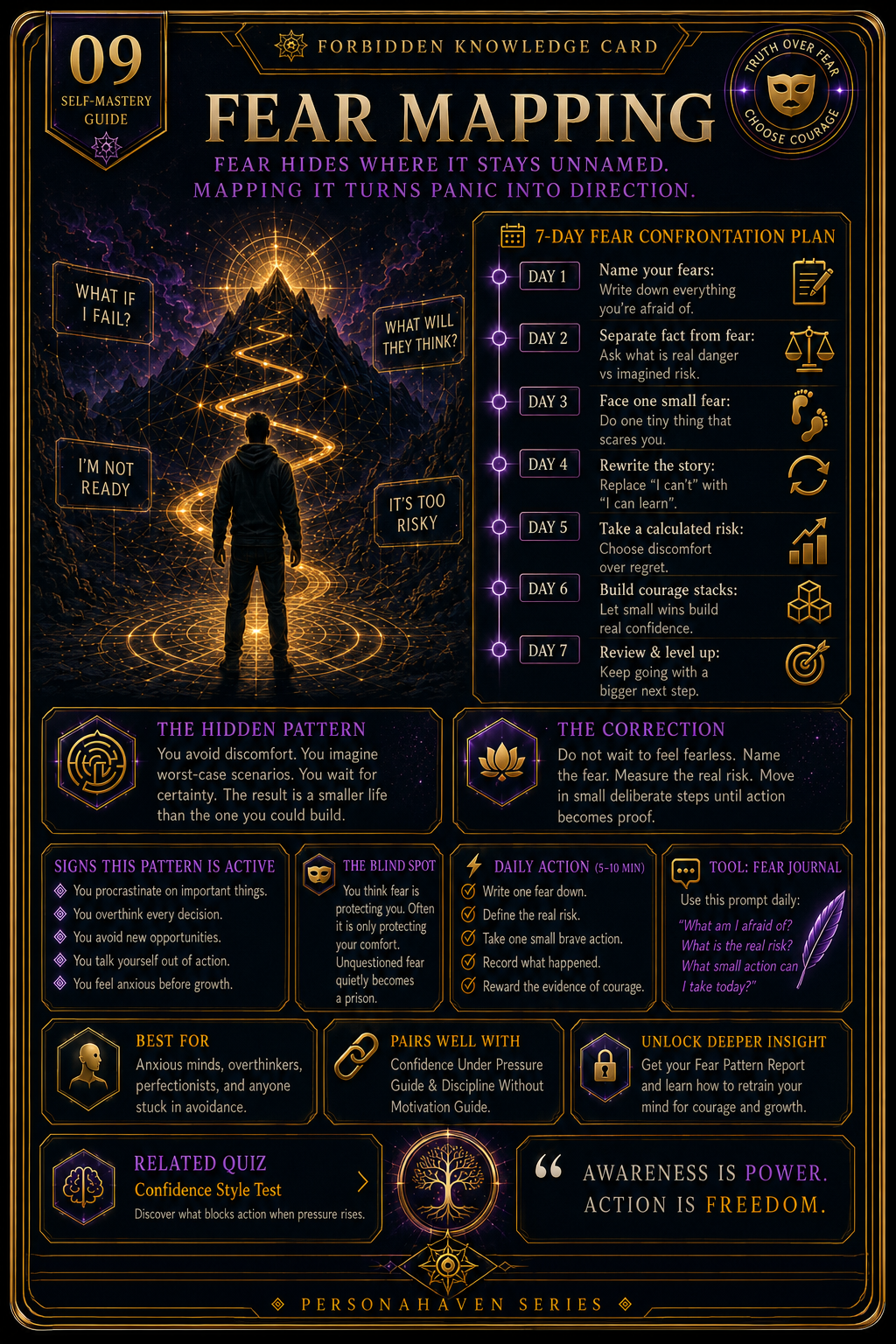
What This Means
Fear mapping means taking the vague fear in your head and making it visible.
Most fear grows in fog.
You feel anxious, but you do not know exactly what you are afraid of. You imagine failure, rejection, danger, embarrassment, loss, or regret all at once.
So your mind does the easiest thing.
It freezes.
Fear mapping breaks the fog into pieces.
What am I afraid of?
What is the real risk?
What is imagined?
What small action can I still take?
Once fear has a shape, it loses some of its control.
The Hidden Pattern
You avoid discomfort.
You imagine worst-case scenarios.
You wait for certainty.
The result is a smaller life than the one you could build.
That is the quiet cost.
Fear does not always look dramatic. Sometimes it looks like “being careful,” “thinking it through,” or “waiting for the right time.”
But if waiting keeps turning into avoidance, fear is making the decision.
Signs This Pattern Is Active
- You procrastinate on important things.
- You overthink every decision.
- You avoid new opportunities.
- You talk yourself out of action.
- You feel anxious before growth.
The Blind Spot
You may think fear is protecting you.
Sometimes it is.
But often, it is only protecting your comfort.
Unquestioned fear quietly becomes a prison.
The danger is not that you feel afraid.
The danger is that you obey fear without checking whether it is telling the truth.
The Correction
Do not wait to feel fearless.
Name the fear.
Measure the real risk.
Move in small deliberate steps until action becomes proof.
You do not defeat fear by arguing with it all day.
You defeat fear by giving your mind new evidence.
One small brave action can do more than a hundred thoughts.
Daily Action
Use the card’s daily action for 5–10 minutes:
Write one fear down.
Define the real risk.
Take one small brave action.
Record what happened.
Reward the evidence of courage.
Do not reward perfect outcomes.
Reward movement.
7-Day Fear Confrontation Plan
Day 1 — Name your fears:
Write down everything you’re afraid of. Do not edit it. Get it out of your head.
Day 2 — Separate fact from fear:
Ask what is real danger vs. imagined risk. Fear often mixes both together.
Day 3 — Face one small fear:
Do one tiny thing that scares you. Keep it small enough that you cannot turn it into a heroic drama.
Day 4 — Rewrite the story:
Replace “I can’t” with “I can learn.” You do not need certainty. You need a better direction.
Day 5 — Take a calculated risk:
Choose discomfort over regret. Not recklessness. A risk you can survive and learn from.
Day 6 — Build courage stacks:
Let small wins build real confidence. Courage grows when evidence repeats.
Day 7 — Review & level up:
Keep going with a bigger next step. Fear shrinks when action becomes familiar.
Tool: Fear Journal
Use this prompt daily:
What am I afraid of?
What is the real risk?
What small action can I take today?
Journal Prompt
Where is fear making my life smaller than it needs to be?
What would I do next if I stopped waiting to feel certain?