Self-Mastery · Guide 07
Confidence Under Pressure
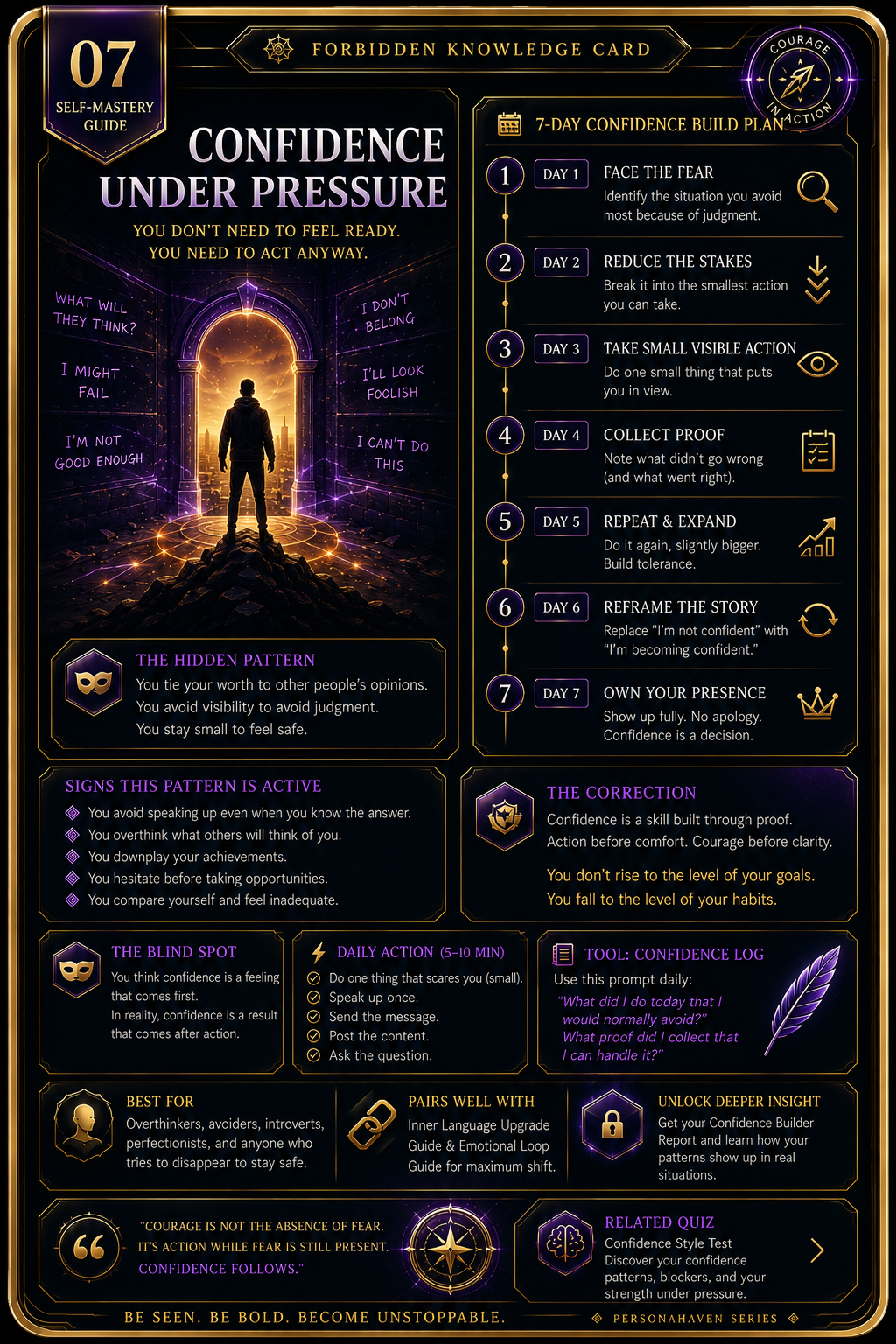
Confidence under pressure means taking a useful next step even when you feel nervous, exposed, or uncertain. Start by lowering the stakes, taking one manageable action, and noticing the evidence that you can cope.
You don’t need to feel ready.
You need to act anyway.
What This Means
Confidence is not the absence of fear.
It is the ability to move while fear is still present.
Most people wait to feel certain before they act. They wait to feel impressive, calm, prepared, accepted, or safe.
That wait can last years.
Confidence under pressure means you stop treating discomfort as a stop sign.
You feel the pressure.
You lower the stakes.
Then you take the next visible step.
The Hidden Pattern
You tie your worth to other people’s opinions.
You avoid visibility to avoid judgment.
You stay small to feel safe.
That is the loop.
You want confidence before action, but confidence usually comes from proof. And proof only comes after action.
If you avoid every moment that could build confidence, your mind never gets evidence that you can handle being seen.
Signs This Pattern Is Active
- You avoid speaking up even when you know the answer.
- You overthink what others will think of you.
- You downplay your achievements.
- You hesitate before taking opportunities.
- You compare yourself and feel inadequate.
The Blind Spot
You may think confidence is a feeling that comes first.
It is not.
Confidence is a result that comes after action.
That does not mean pretending fear is gone. It means refusing to let fear make every decision.
The goal is not to become fearless.
The goal is to become someone who acts before fear finishes its argument.
The Correction
Confidence is a skill built through proof.
Action before comfort.
Courage before clarity.
You don’t rise to the level of your goals.
You fall to the level of your habits.
So build the habit of showing up before you feel impressive.
Small visible action is the training ground.
Daily Action
Use the card’s daily action for 5–10 minutes:
Do one thing that scares you (small).
Speak up once.
Send the message.
Post the content.
Ask the question.
Do not aim for perfect. Aim for visible.
7-Day Confidence Build Plan
Day 1 — Face the Fear
Identify the situation you avoid most because of judgment. Be honest about what you are afraid people will think.
Day 2 — Reduce the Stakes
Break it into the smallest action you can take. Make it too small to dramatize.
Day 3 — Take Small Visible Action
Do one small thing that puts you in view. Say the sentence. Join the conversation. Share the idea.
Day 4 — Collect Proof
Note what didn’t go wrong, and what went right. Your mind needs evidence, not speeches.
Day 5 — Repeat & Expand
Do it again, slightly bigger. Build tolerance. Confidence grows through repeated exposure to the thing you avoid.
Day 6 — Reframe the Story
Replace “I’m not confident” with “I’m becoming confident.” One sentence changes the frame.
Day 7 — Own Your Presence
Show up fully. No apology. Confidence is a decision.
Tool: Confidence Log
Use this prompt daily:
What did I do today that I would normally avoid?
What proof did I collect that I can handle it?
Journal Prompt
Where am I waiting to feel ready before I allow myself to be seen?
What small action would prove that I can move before I feel confident?